Blog or Web Search

2014/07/30

This is my article on BESIG Newsletter: GENERATION Z, ENGLISH and the QR CODE. Hope you enjoy!

Hello, dear ones.


I would like to share with you my article Generation Z, English and the QR
Code, which was puplished on THE NEWSLETTER OF THE BUSINESS ENGLISH SPECIAL INTEREST GROUP, SUMMER 2014, ISSUE 87, p. 15.

I'll be glad if you could post your comments on if you agree or disagree with the points raised in the text. Here are some to reflect on:
  1. Do you have anyone in your family that is part of the Generation Z? How do they behave? How to prepare them to enter the labor market? 
  2. Coaching role and Teaching role. Do they interact or conflict with each other? Why?
  3. What do you value most: your soft or hard skills? Why?                    
(soft skills = empathy, teamwork, leadership, communication, good manners, negotiation, sociability, for instance; hard skills = machine operation, computer protocols, safety standards, financial procedures, sales adiministration, for instance)

   4. What is an English teacher's role?

Hope to see your full participation here.

Best,

Flávia

2014/06/08

The World Cup Kick-off !!


Hello, everyone!

I invite you all to actively participate in this month blog post - The World Cup - by watching videos, reading articles, learning new vocabulary thru fun exercises, and sharing your opinion with your virtual classmates on this world event, which this year is being held in Brazil.

You can start by forecasting your score for the first game: Brazil x Croatia (June 12th at 5pm): .......... x ..........

Hope to see your comments on the Comment box (below this post) and the interaction with your blog friends.
Fingers crossed and let's wish the best to all the world teams!
Have a great World Cup!
Flávia
Let's get started! After each activity below (aimed at different language levels), there are some questions you can choose from to answer:

1) Fifa official song lyrics: We are one
   (Pitbull, Jennifer Lopez and Claudia Leite)
What do you think of the lyrics? Did you like the three singers singing in 3 languages? Why?

2) Vocabulary: 
a) Look at the picture of the soccer field and players' position. For fun, you can name our Brazilian players next to their posts.


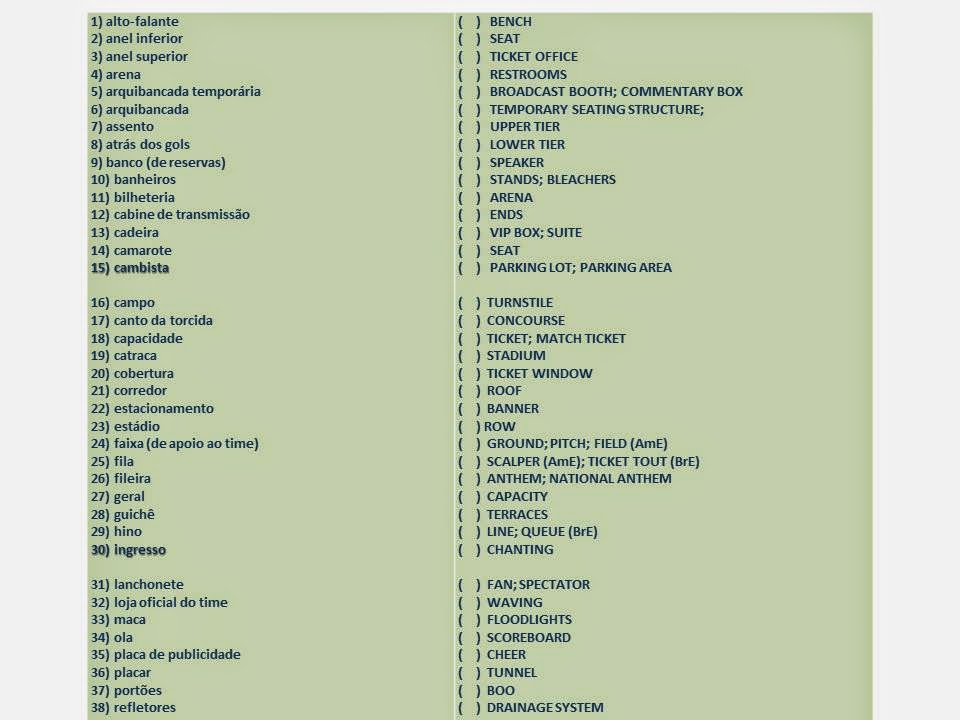
b) Below, you will see lots of words related to the Soccer Stadium. Match the Portuguese words on the left with their corresponding English translation on the right. The teacher will give the correct answers in class:


b)  Crossword Puzzle: Soccer expressions and vocabulary. The teacher will give the correct answers in class: 


3) Soccer History - Listen to the mp3 files below and fill in the blank spaces in the passages that follow. Then, answer the True or False questions proposed in part 2:


4) World Cup team profile: Brazil - Youtube video
Interviews with Neymar, coach Luis Felipe Scolari and others, this is a special look back at Brazil's FIFA World Cup history and what to expect from the hosts in Group A against Croatia, Mexico and Cameroon.

Did you like the way Fifa showed the interviews with our players and coach, as well as Brazil's history? Why?

5) The Economist article: Footbal: Beautiful game, dirty business (Jun 7th, 2014) 
      Football is a great sport, but it could be so much better if it were run honestly.
After you read the article below, you'll work on the vocabulary exercise by matching the words in bold extracted from the passage with their corresponding meaning on the right.

Question: Do you agree with the criticism proposed in the article? And the solutions brought up?


2014/02/17

Let's Go to the Oscar 2014! If not in the flesh, at least here on the blog!


Hello, everyone.
The Oscar Ceremony is near, on March 2nd . So, I invite you all - students and ex-ones, movie buffs or not - to post your comments on the following  and other categories, having in mind some questions posted below:


Best Picture

View Trailer / More Information 

View Trailer /  More Information       


Gravity
View Trailer / More Information           
 
Her

Best Actor in a Leading RoleChristian Bale
American Hustle
 
Chiwetel Ejiofor
 12 Years a Slave
 
Bruce Dern
Nebraska
 
Matthew McConaughey
Dallas Buyers Club
 
Leonardo DiCaprio
The Wolf of Wall Street
 
 
Best Actress in a Leading Role:
Amy Adams
American Hustle
 
Judi Dench
Philomena 
 
Cate Blanchett
Blue Jasmine


Meryl Streep
August: Osage County
 
Sandra Bullock
Gravity


For more information, please go to: OSCAR official site

The other categories are: Best Actor in a Supporting Role, Best Actress in a Supporting Role, Animated Feature Filme, Cinematography, Costume Design, Directing, Film Editing, Makeup and Hairstyling, Music (Original Score), etc.

Watch this movie for the nominees anouncement:

These are the questions proposed: 


1) Have you seen all the films? Which ones have you seen? Which one should win? Why?

2)Which actor/actress should get the statuette for leading and supporting roles?Why?


Similar to last year,  I propose a different participation - through the audio activity VOXOPOP. This is a valuable voice tool that can help you boost your speaking skills and also integrates the participants. See below how it works:


2)  Go to Voxopop of 2013 on the Oscar to see how the students participated. In order to participate in this talkgroup: The talkgroup Oscar Nominees 2014, you'll have to  Sign up to VOXOPOP to create a login and password.


3) Oscar Nominees 2014 voicethread You just click on the RECORD A MESSAGE button and post your opinion after mine. Give it a try, ok?  

Hope you enjoy this new activity! Count on your participation!
Flávia

2014/01/08

Happy, Profitable and Fruitful 2014, everyone! Time to think about and share your New Year's resolutions! Ready?


Dear students,
 
Hope you all had a great 2013 Season's celebrations and are ready to start or restart your English studies!
 
Have you already made a list of things you wanna change from last year? Or have a list of new things you wanna do this year? If so, how would you like to achieve them?
 
I'd like to see your  participation  by engaging in this post discussion as a 2014 warm-up activity. Let's make it happen!
 
To warm up the discussion, click on the US Today video link that follows to watch the reporter talk bout New Year's resolutions for 2014.  Do you agree with them? Why?
 
Then compare the video with the Reading that follows. Check whether or not the video corresponds to the reading and why.
 
Post your comment at the end. If you want me to correct first, send me an email and I'll promptly correct it.
 
Wish you all your plans and wishes come true in 2014!!
 
Flávia
 
 
As you welcome 2014 and attempt to fulfill that big goal of yours, don't panic.
Scranton University psychology professor John Norcross is offering ways to follow through on your New Year's resolutions.
 
Last year, 40% of Americans planned to make resolutions on Jan. 1. Popular ambitions included the usual suspects: losing weight, improving finances, quitting smoking and reducing alcohol use.
 
 
"Resolutions have been uncannily similar and stable over the years," Norcross said.
 
But, the author of Changeology: 5 Steps to Realizing your Goals and Resolutions says resolutions are hard to keep for many Americans. Last year, Norcross predicted 50% would break one, if not all, of their goals by mid-January.
 
Here are some tips from Norcross to keep your New Year's goals. And remember, it's a marathon, not a sprint!
 
1) Make changes to your behavior. Changing your routine can bring different results. Instead of trying the same thing over and over again, expecting a different outcome, people need to modify their behaviors.
 
2) Define SMART goals. When setting targets, use the SMART acronym: specific, measurable, attainable, relevant and time-specific. Norcross says that individuals must go further than simply saying, "I want to lose weight." "Specifically, what are you going to do so that you can measure and track [your weight] over time, for say, the next three to four months?" he said.
 
3) Track your progress. Norcross calls this technique self-monitoring. A calendar, or a calendar app, is a handy tool you can use to track your goals. "It also can show you what the triggers of your behavior are and it can alert you to any early slips," Norcross says.
 
4) Reward small achievements. When you reach a portion of your goal, as an example you lose 10 of those 25 pounds, be kind to yourself. Recognize the accomplishment and perhaps do something nice for yourself. This will help keep you focused and excited about the overall goal.
 
5) Make it public. When individuals announce their goals on social media, to their families or in the workplace, they are being held accountable by those closest to them. The upside to this, Norcross says, is it can keep you on track. The downside: "It potentially increases embarrassment if they fail," he said. So, it depends on how open you want to be about your resolutions.
 
6) You are human. Chances are you may slip up once or twice during this process. It's OK. Norcross says it is important to deal with failures by getting back on track and continuing along your journey. Seventy percent of successful goal-setters said that their first slip actually strengthened their resolutions. Norcross says to adopt the outlook, "I'm human. Let me learn from it, and let me keep going."

2013/10/28

Time for Halloween!! Wish you all a Spooky and Scary Halloween, but full of fun!

DEAREST ALL!!!

Let's warm up our brains by getting acquainted with some Halloween Vocabulary. 
Hope you like this fun activity.


Now, you are going to listen to a short story narrated by your teacher. You'll have the challenge to fill out the spaces, while listening. Pretty easy, I can say. 
So have a good time! Just click on this link:  A Halloween Story

As a kid, I always liked Halloween. I liked dressing up in a 1 …………………that I pick out at the store or, more often, we 2…………. out of odds and ends at home. The best part  3………  …………… trick-or- treating. Some years, I went with my brothers and sisters. When I got a little  4………….., I went with my friends. We would go to the houses in our  5………………….. and knock or ring the doorbell. When the 6 …………. opened, we would yell, "Trick or treat!‚" We never played  7……………… and always got treats. The neighbor would put some candy and chocolate bars in our bags. We would go home at the  8……..  of the night and eat them to our 9…………………' content.

To get ready for Halloween, my parents  10…………  ……………. pumpkins from the 11…………..or from the make-shift pumpkin patches on the  12…………….of the road so that we could make jack- o- lanterns. We 13 ………… each pumpkin and cut off the top, scooped 14…….. the seeds from the inside, and 15………….. faces on the front. At night, we would put 16………….  inside the jack-o- lanterns and put them on our doorstep. Sometimes we carved scary faces and sometimes they were funny ones.

I remember that one year, we had a Halloween  17………….. Our friends 18 …………..   ………… dressed up as witches, ghosts, superheros, cartoon characters, and anything else you can think of. We would play 19………………… games like bobbing for apples, and we even created a haunted house in our 20…………... It was a blast! Halloween is truly a holiday for kids. 


Script by Dr. Jeff McQuillan – www.eslpod.com – Episode 73 (for all the explanation on the terms)

Hope to see your full participation here! 

Flávia
BOOOOO!!!!


2013/09/08

How old should you be to make the difference? Remarkable or Crazy people? You decide.

Hello, dearest students.
 
I've come across very interesting people lately and would like to invite you all to get to know them by watching the videos and listening to the material proposed.

Then,  post your opinion on who you consider the most important person to make the difference in the world and why. Who do you consider crazy and why?
 
Hope you get inspired by these people and use this tool to boost your English writing!
 
Make your thoughts known by communicating them through the language to be mastered.
 
Cheerio!
 
Flávia


1) Video: Meet Ryan Hreljac - the Canadian youngster

His Site: The Ryan's Well Foundation


(on the Ted.com video, select the language so that the captions in English appear at the bottom)

His Biography: Elon Musk's profile


3) Video: Google founder Sergey Brin talks about Google burger.

Listen to  Breaking News English: People Eat 1st Google Burger  . Then, fill out the spaces below.

Once on the site, please click on the MP3 link (either American or British pronunciation):


Two food critics have eaten meat that was grown in a (1) ____________. It is the first time anyone has eaten (2) ____________ meat. The experiment is part of a project run by Google co-(3) ____________ Sergey Brin. He invested over $380,000 in research for the burger. It took a team of scientists at a university in Holland over two months to grow the meat for the patty. They used (4) ____________ cells from a cow and grew 20,000 (5) ____________ pieces of meat. These were mixed with salt, egg powder, breadcrumbs and other (6) ____________ to make the burger. Mr Brin hopes artificial meat will become part of our diets in ten years. He wants to (7) ____________ animals from being killed for food. He also knows stem-cell meat will be (8) ____________ for the environment.

Mr Brin's burger was put to the taste (9) ____________ on Monday. Two food experts tried the beef burger. An English (10) ____________ fried it in sunflower oil and butter. Austrian food scientist Hanni Rutzler said it was "close to meat" but it "(11) ____________ juiciness". She also thought it was a little harder than she (12) ____________. US author Josh Schonwald commented that it was a little dry but was like a real burger. He said: "The absence is the (13) ____________. It has a leanness but the bite feels like a (14) ____________ hamburger." Many journalists wanted a (15) ____________, but there was only one burger. Lead researcher Mark Post said he would give any (16) ____________ to his children. He said cells taken from one cow could produce 175 million burgers.


2013/06/30

Post your views on either of these 2 hot topics: New Rules Aim to Rid Schools of Junk Foods & Dilma's reforms


Hello, everyone.

Hot topics in the news recently awaiting your live participation!

So, choose one of the articles below to read and give your comments on it. Always remember to propose a question so that your virtual friends can be challenged to answer.

The 1st article -  New rules aim to rid schools of junk foods - discusses the changes of US regulations for healthier school foods to be implemented. What do all the players (retailers, schools, family, kids) think about it? 

The 2nd article - Dilma's reforms: what she should do, and why she won't - discusses the measures to be taken by our president and if they will really happen in the short, mid and long terms, after the intense protests that have been seen recently in many Brazilian state capitals.

Keep up with the news and at the same time practice the English language.

Count on your participation!

Best wishes,

Flávia

New rules aim to rid schools of junk foods

Associated Press
MARY CLARE JALONICK 5 hours ago HealthVending machineSports drink

WASHINGTON (AP) — High-calorie sports drinks and candy bars will be removed from school vending machines and cafeteria lines as soon as next year, replaced with diet drinks, granola bars and other healthier items.

The Agriculture Department said Thursday that for the first time it will make sure that all foods sold in the nation's 100,000 schools are healthier by expanding fat, calorie, sugar and sodium limits to almost everything sold during the school day.

That includes snacks sold around the school and foods on the "a la carte" line in cafeterias, which never have been regulated before. The new rules, proposed in February and made final this week, also would allow states to regulate student bake sales.

The rules, required under a child nutrition law passed by Congress in 2010, are part of the government's effort to combat childhood obesity. The rules have the potential to transform what many children eat at school.

While some schools already have made improvements in their lunch menus and vending machine choices, others still are selling high-fat, high-calorie foods. Standards put into place at the beginning of the 2012 school year already regulate the nutritional content of free and low-cost school breakfasts and lunches that are subsidized by the federal government. However most lunchrooms also have the "a la carte" lines that sell other foods — often greasy foods like mozzarella sticks and nachos. Under the rules, those lines could offer healthier pizzas, low-fat hamburgers, fruit cups or yogurt, among other foods that meet the standards.

One of the biggest changes under the rules will be a near-ban on high-calorie sports drinks, which many beverage companies added to school vending machines to replace high-calorie sodas that they pulled in response to criticism from the public health community.

The rule would only allow sales in high schools of sodas and sports drinks that contain 60 calories or less in a 12-ounce serving, banning the highest-calorie versions of those beverages.

Many companies already have developed low-calorie sports drinks — Gatorade's G2, for example — and many diet teas and diet sodas are also available for sale.

Elementary and middle schools could sell only water, carbonated water, 100 percent fruit or vegetable juice, and low fat and fat-free milk, including nonfat flavored milks.

First lady Michelle Obama, an advocate for healthy eating and efforts to reduce childhood obesity, pointed out that many working parents don't have control over what their kids eat when they're not at home.

"That's why as a mom myself, I am so excited that schools will now be offering healthier choices to students and reinforcing the work we do at home to help our kids stay healthy," Mrs. Obama said in a statement.

At a congressional hearing, a school nutritionist said Thursday that schools have had difficulty adjusting to the 2012 changes, and the new "a la carte" standards could also be a hardship.

Sandra Ford, president of the School Nutrition Association and director of food and nutrition services for a school district in Bradenton, Fla., said in prepared testimony that the healthier foods have been expensive and participation has declined since the standards went into effect. She also predicted that her school district could lose $975,000 a year under the new "a la carte" guidelines because they would have to eliminate many of the foods they currently sell.

"The new meal pattern requirements have significantly increased the expense of preparing school meals, at a time when food costs were already on the rise," she said.

Ford called on the USDA to permanently do away with the limits on grains and proteins, saying they hampered her school district's ability to serve sandwiches and salads with chicken on top that had proved popular with students.
The Government Accountability Office said it visited eight districts around the country and found that in most districts students were having trouble adjusting to some of the new foods, leading to increased food waste and decreased participation in the school lunch program.

However, the agency said in a report that most students spoke positively about eating healthier foods and predicted they will get used to the changes over time.

One principle of the new rules is not just to cut down on unhealthy foods but to increase the number of healthier foods sold. The standards encourage more whole grains, low-fat dairy, fruits, vegetables and lean proteins.

"It's not enough for it to be low in problem nutrients, it also has to provide positive nutritional benefits," says Margo Wootan, a nutrition lobbyist for the Center for Science in the Public Interest who has lobbied for the new rules. "There has to be some food in the food."

The new rules are the latest in a long list of changes designed to make foods served in schools more healthful and accessible. Nutritional guidelines for the subsidized lunches were revised last year and put in place last fall. 

The 2010 child nutrition law also provided more money for schools to serve free and reduced-cost lunches and required more meals to be served to hungry kids.

Last year's rules making main lunch fare more nutritious faced criticism from some conservatives, including some Republicans in Congress, who said the government shouldn't be telling kids what to eat. 

Mindful of that backlash (a strong or violent reaction), the Agriculture Department left one of the more controversial parts of the rule, the regulation of in-school fundraisers like bake sales (a sale of homemade, donated baked goods, as by a church or club to raise money), up to the states.

The new guidelines also would not apply to after-school concessions at school games or theater events, goodies brought from home for classroom celebrations, or anything students bring for their own personal consumption.

The USDA so far has shown a willingness to work with schools to resolve complaints that some new requirements are hard to meet. Last year, for example, the government temporarily relaxed some limits on meats and grains in subsidized lunches after school nutritionists said they weren't working.


The food industry has been onboard with many of the changes, and several companies worked with Congress on the child nutrition law three years ago.

Dilma’s reforms: what she should do, and why she won’t

Jun 25, 2013 9:13pm by Joe Leahy
http://blogs.ft.com/beyond-brics/2013/06/25/dilmas-reforms-what-she-should-do-and-why-she-wont/ Authorised= false# axzz2Xiy9JXVS      

After a meeting with governors and mayors on Monday called in response to the biggest protests in Brazil in nearly a generation, President Dilma Rousseff announced five pacts ranging from political reform to better public health.

Here is a list of the five, their likelihood of being effective (mostly very little), followed by a beyondbrics wishlist and its likelihood of happening (next to zero).

Dilma’s pacts:

1.   Maintain fiscal responsibility – This was already deteriorating and it is hard to see how governments will maintain the line now with even greater pressure for better services following the protests.

2.   Plebiscite – hold a referendum to set up a constitutional assembly on political reform. Verdict: Unnecessary as Congress could implement political reform itself if it really wanted to. Likely to get lost in Brazil’s labyrinthine political system.

3.   Fight corruption through classifying graft as a heinous crime. A start but will make little difference without a functioning legal system (see below). Brazil has no shortage of good laws, it’s just a matter of implementing them.

4.   Accelerate investment in hospitals and clinics, import foreign doctors. Er … in government, isn’t this is called just doing your job? Still, better than nothing.

5.   R$50bn for investment in public transport. Haven’t we already established the issue in Brazil is not how much money you throw at a problem but implementation?

Beyondbrics’ wishlist:

1.   Ministers – immediately slash the cabinet from 39 or 40 ministers presently to 15. Likelihood of happening – zero. In Brazilian politics no one wants to be in opposition.

2.   Present a coherent short, medium and long-term vision for the economy based on orthodox economics. Reshuffle the cabinet to include people with international, private sector experience at the highest level of business. Likelihood of happening – near zero. Would be too painful for vested interests. Could result in a short recession ahead of an election year.

3.   Insist to her Workers’ Party that all mensaleiros, those cadres sentenced to jail for corruption last year in Brazil’s biggest corruption case, immediately be suspended from Congress until the appeal process is concluded. Likelihood of happening? Near zero. Dilma cannot afford to confront the core of her party.

4.   Introduce reforms to speed up court cases so that none last for more than five years. Likelihood of happening? Close to zero. Congress would never have it – too many legislators are facing legal processes themselves.

5.   Reduce bureaucracy immediately by set targets. For instance, enable businesses to be opened in three days instead of 121. Likelihood? Not happening – Brazil’s tangled bureaucracy is stuck in a maze of red tape.

The crux of the matter is that ultimately, it is not in the president’s political interests to be seen taking radical steps at this stage. That would be akin to admitting she is the problem. That is why she has sought to include Congress and the governors and mayors in a national dialogue.

So where does that leave us? Where we started. Only direct, sustained public pressure on Brazil’s politicians of the kind seen this month will speed up the glacial pace of change in the system.